
When I got cheated on, I consumed a lot of literature. Podcasts, books, relationship articles. There were a lot that sought to excuse the cheater’s actions, yet they seemed to form the zeitgeist around infidelity and cheating. I touch briefly on some of the articles here. However, please feel free to use the contact form to send in suggestions on any other literature you would like a breakdown on.
It’s worthwhile to note that the views here refer to those by third-parties, usually some form of media outlet expressing views more forgiving to a cheater. I wrote a related, but separate post to cover the gaslighting that cheaters themselves will use. Please refer to that if you are struggling with the excuses that your cheater might have imposed on you.
Let’s unpack these:
1. A cheater could have been driven to cheat by faults of their partner (neglect/bad sex/bored/not attracted/communication breakdown etc…)
It shocks me how far some people can take it. In this Daily Mail article, I find the following argument:
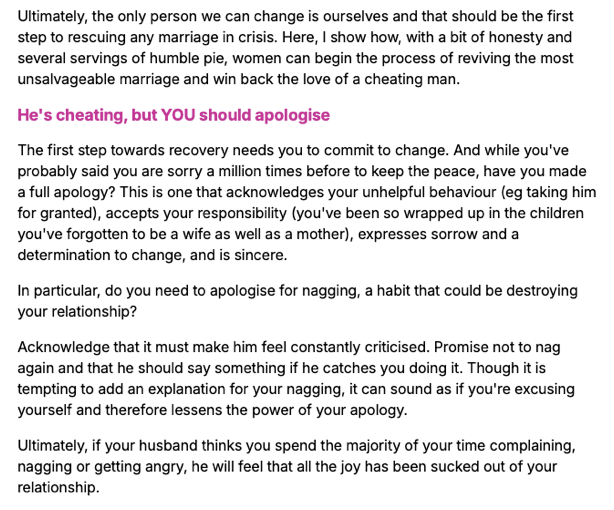
The logic here is so weak that it is almost shooting fish in a barrel, but in a vulnerable state after cheating it might be persuasive, which is why I am addressing it.
“The only person we can change is ourselves..” – this is a platitude. Or is it? We can also choose to change our partners for someone loyal. I find it disturbing that the immediate underlying assumption is that the marriage needs to be saved at all cost, even if the cheater has already destroyed it. The article then wraps assumptions about the situation into seeming fact. The article posits that the betrayed partner has engaged in unhelpful behaviour, such as nagging. Suddenly, every woman who has been cheated on took the husband for granted, forgot to be a wife, nags etc. Without these innate assumptions, the argument falls apart. Furthermore, the implicit assumption suggests that infidelity is driven by the shortcomings of the wife, which is why the article feels comfortable making these assumptions. Notice how no flaws of the husband are brought up.
This common excuse is based on the fundamentally flawed conflation of the failure of a relationship with cheating. This is a terrible notion that beggars belief. It appeals to the convenient heuristic that any relationship dynamic comes from both parties.
No matter what problem a couple faces in their relationship (and all these are normal), it is always a conscious decision to lie to your partner. When faced with a problem, you can either work through it, or choose to leave. I’m fully in support of the notion that in a break-up, both parties should examine how they could have improved. However, breaking up is upfront and honest. There are scarcely any scenarios where a person should cheat instead of breaking up (so scarce that I’ve yet to hear of any, happy to stand corrected on this absolutist statement if you care to bring this up in the comments).
Cheating is an act that screams entitlement: The cheater doesn’t want to resolve it, or wants to keep the benefits from being in a relationship while depriving the other of it.
Never forget, when a person says that they cheated because of neglect or lack of attraction etc, the implicit assumption is that their partner doesn’t feel the same way. Through this assumption, they deprive their partner of the benefits of polyamory, while enjoying these very benefits illicitly.
Funnily enough, those who espouse this view will be quick to clarify that they don’t mean that the cheated on is responsible for the cheating. Instead, they couch it as a lack of communication. That begs the question: Whose fault do they believe it is? The hesitance to absolve the cheater of responsibility ignores the fact that the cheated on have no control over their partner’s infidelity.
2. Couples have survived infidelity, the cheater still loves their partner
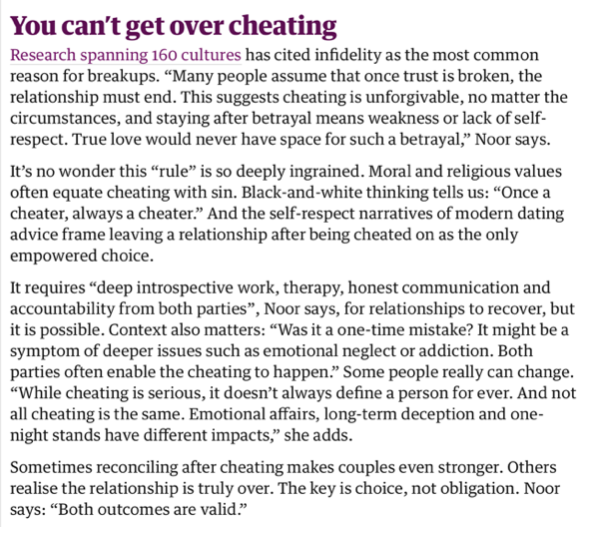
On a preliminary glance, it sounds at best like friendly advice, at worst an empty platitude. In an ideal world, everyone would show grace. To turn the other cheek is a virtue after all. Cheating is however the one act that somehow lets some feel comfortable advocating for the victim to forgive and forget. We must be cognisant that the victim is the primary one who needs support. To pin the responsibility of forgiveness on them is absolutely ludicrous. We would not tell the victim of a crime to just let it go instead of notifying the police, because of some vague notion of compassion. You can replace infidelity here with anything – stabbing, assault. It’s similar to (1), where this excuse shifts the responsibility of moving forward to the victim instead of acknowledging the blame attributable to the cheater. This notion is actually far more pertinacious.
This is another way to subtly blame the cheated on for the ruination of the relationship, this time after the cheating has occurred. A victim of infidelity who walks away is deemed to have given up on the relationship. Instead of pinning the accountability on the cheater, the romanticising of the couple that works hard together to overcome cheating implies that the cheated on is lacking.
The opening of possibilities is always a tricky one that plays on the common sensical approach of never being an absolutist. However, this falls apart when we consider that anything is possible. Just because it’s possible for me to become very rich by buying the lottery with my life savings, doesn’t mean that it’s the right thing to do.
It’s not sufficient to say something is possible, you need to consider the probabilities and hence weigh the expected value against the costs.
3. Cheating being a grey area
The article referenced above in (2) also noted how context matters when it comes to an affair.
Many things in life lie on the spectrum. I don’t deny that – a prolonged affair is different from a one night stand. Simultaneously, I believe that the tolerance for infidelity is so low, that only the very very mild end of the infidelity spectrum should even be given a second’s consideration for forgiveness.
First, to set it on a spectrum already assumes that the cheater is honest about what they have done. The assumption easily falls apart however. Many cheaters downplay what has occurred, or conceal the extent of how they cheated. Unlike a crime, the police will not invest resources into helping a victim of infidelity dig into security footage or text messages. There is almost no way to be certain without expending massive resources at your own cost. The easiest test is whether the cheater hid an act, or lied about it happening. If they do, it means that they clearly understood this violated the boundaries of their partner.
“You don’t try to be loyal. You just are, or you’re not” – Bobby Axelrod, Billions
Some will obfuscate the issue by claiming that an affair is always a complex issue with “layers”. Maybe the cheater had a difficult childhood, or there was some perceived slight. Heavens, his wife couldn’t juggle doing all the chores and neglected his back rub so he cheated! Or her husband who was working 70 hour weeks made her feel ignored so she cheated! Frankly, this feels like yet another platitude. Everybody has faced difficulties. That is zero excuse to then turn around and hurt someone. A rapist can have a terrible childhood. A thief could be a person who didn’t know better. I say these not to equate cheating with severe crimes, but to point out that many of these “mitigating factors” often are feeble excuses in disguise.
4. Attribution to external circumstances
“It was a spur of the moment”, “It just happened”, or my favourite: “I don’t know”. It’s a very infantile excuse, but at least it’s the most honest excuse of the list given how infantile cheating is.
The excuse helps to shift the responsibility of being a person of integrity to some vague environmental variable. Perhaps the cheater does it to cope with the fact that they have been exposed to have a flawed morality.
Alcohol consumption provides another common external excuse, but legal systems worldwide recognise that voluntary intoxication generally does not negate personal responsibility. Singapore’s legal framework illustrates this principle clearly: voluntary intoxication is not accepted as a defence for general intent crimes, and even for specific intent offences, the individual must have been so severely impaired that they could not form the required mental state. This legal standard reflects the understanding that alcohol affects judgement rather than eliminating it entirely.
The key distinction lies between circumstances that influence decision‑making and circumstances that eliminate choice altogether. Environmental factors can create pressure, opportunity, or reduced inhibition, but they rarely if ever eliminate the capacity for moral reasoning entirely.
5. Biological programming
If this is based on gender, then it is plain sexist and unbacked by scientific literature. There are many people of all genders that do not cheat, because they recognise that it’s a depraved thing to do.
The biological determinism argument for infidelity relies on oversimplified evolutionary narratives that misrepresent both scientific findings and human behavioural flexibility. Popular claims about evolutionary psychology often commit the fallacy of biological determinism, suggesting that genes control behaviour directly rather than through complex interactions with environment and conscious choice. The claim that “men are wired to spread their seed” is thoroughly debunked by evolutionary psychologists. Leading biologists like E.O. Wilson explicitly argued for environmental influence and human flexibility rather than genetic determinism, stating that while genes maintain some influence, they have “given away most of their sovereignty” to environmental factors. The scientific consensus recognises that evolutionary pressures create tendencies rather than imperatives, and that humans possess exceptional behavioural flexibility compared to other species.
If a person remains unable to resist their hormonal urges, that’s a lack of discipline. We have evolved into civilisation, growing far beyond many limits that our cavemen ancestors possessed. You have to question whether someone who falls back on primitive tendencies is even worth associating with.
The harms of these flawed rationale
When someone is cheated on, and they get these excuses instead of an apology, it casts the pain they feel into doubt. It’s cruel gaslighting, and these need to be actively pushed back upon. In the end, navigating the revelation of cheating is complicated enough without adding a side order of blame and platitudes. Let’s stop pretending that every relationship can or should be salvaged at any cost, and instead focus on respect, communication, and a bit of self-worth. If you’re facing infidelity, remember: you’re not obliged to play the martyr for the faults of someone else.
Take care of yourself. You’re stronger than you know, and you will get through this.
Join the Discussion on Reddit